Introduction: The Search for Something More
Many of us feel an innate pull toward something more—a deeper meaning to our existence, a sign from the universe, or a miracle cure for what ails us. We look for answers in ancient texts, complex rituals, and mystical practices, hoping to connect with a power beyond our ordinary lives. We search the heavens for guidance, believing the most profound truths must be shrouded in supernatural mystery.
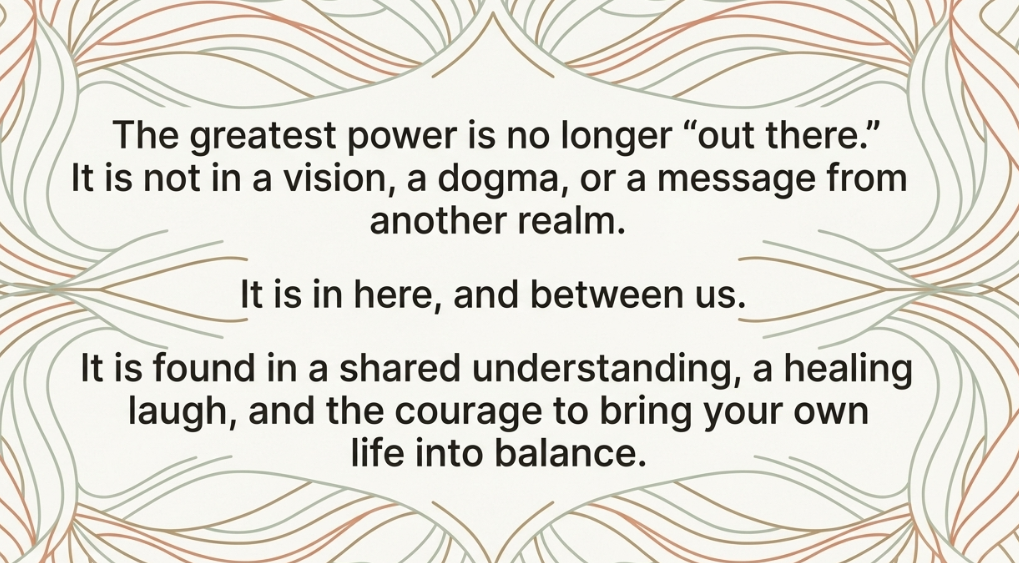
But what if the most transformative wisdom isn't hidden in the extraordinary? According to a series of profound teachings, the greatest truths are often simpler, more direct, and far more counter-intuitive than we imagine. They suggest that the real work isn't about reaching for the divine, but about grounding ourselves more deeply in our own humanity. This article distills four unconventional truths that shift our focus from the heavens back to our own lives, revealing a practical path to power, healing, and connection.
--------------------------------------------------------------------------------
1. Spiritual Powers Can Signal Loneliness, Not Enlightenment
In many spiritual traditions, experiencing phenomena—seeing visions or communicating with spirits—is seen as a mark of advancement. But these teachings deliver a jarring re-appraisal: such experiences are not a strength, but a symptom of a void. More than that, they are a dangerous distraction from our true purpose.
According to this view, the spiritual realm intervenes precisely when our human connections fail. When a person is lonely, struggling, and unable to communicate with those around them, otherworldly forces emerge to fill the vacuum. This isn't a reward, but an emergency response to an unmet human need. The speaker’s urgency on this point is palpable, warning that a fixation on these abilities is a detour from the real work of living. This powerfully reframes the spiritual journey. The goal is not to seek supernatural encounters, but to turn away from them and master the difficult art of cultivating clear, honest communication with the people standing right next to us.
"In the new era, when we become lonely and struggle, spiritual powers come to us. The ancestors come, the gods come, all sorts of things come. Why? Because I am lonely. Because I am struggling. Because I cannot communicate with anyone... Is this a good thing? It is not a good thing."
--------------------------------------------------------------------------------
2. The Ultimate Cure for Illness Isn't a Secret—It's Laughter
This re-prioritization of the human over the supernatural is not just about visions; it extends to the very core of our physical well-being. When faced with chronic illness, we often seek complex causes and cures. This philosophy argues the root is far simpler: illness stems from a hardened disposition, an inflexible stubbornness that accumulates over time.
This stubbornness can even hide behind perceived virtues. The person who rigidly insists, “I am a nice person,” or “I am a law-abiding person,” is displaying a form of 고집 (gojip), or stubbornness, that blocks the flow of life. The prescribed medicine is not a pill or a prayer, but a principle of radical reversal. The cure is to consciously invert the very patterns that created the sickness. If you were always scowling and serious, the cure is to laugh. If you were overly rigid in your belief that you were “nice,” the cure is to become flexible enough to accept that life requires more than just niceness. The body has an immense, innate capacity to heal, and this reversal can trigger that process with startling speed.
"There is only one way to solve this illness. Become incredibly fun. Then the illness is cured. Live with laughter... If you were always scowling... then laugh. Reverse it."
--------------------------------------------------------------------------------
3. Spiritual Abilities Run on a 'Credit Limit'
In our modern world, we understand assets and liabilities. This teaching applies this same pragmatic lens to the mystical realm, recasting psychic power not as a magical gift, but as a form of spiritual capital with strict limits.
These abilities are not an infinite personal wellspring. Instead, they are a finite resource—a "credit limit"—granted by higher-level public spirits (성관) to one's personal ancestral spirits (서인). This heavenly credit can be exhausted through overuse or revoked entirely if misused or if the individual fails to develop their own inner wisdom. This illustrates a crucial point: relying on borrowed power is an inherently weak position. Real strength comes from genuine study and self-development. From this perspective, the act of "going to the mountain to pray" is stripped of its romanticism. It is revealed as an act of desperation—a shaman, having depleted their spiritual credit, going to the freezing, harsh mountains to beg, to panhandle for an extension from the spirits.
"You are given a 'credit limit' on the power you can use... When this limit is depleted, you cannot use that power anymore... So they go to the mountains to pray... This is like going to panhandle."
--------------------------------------------------------------------------------
4. The Most Sacred Act Is a Simple Conversation
These three truths converge on a single, revolutionary message. The teachings consistently dismantle traditional spiritual hierarchies, de-emphasizing the supernatural in favor of the profoundly human. Visions are a symptom, complex illnesses yield to simple joy, and psychic powers are merely a limited loan. What, then, is truly superior?
The answer is the most overlooked spiritual practice of all: direct, honest, human-to-human conversation. In this philosophy, the real work is not learning to communicate with spirits, but learning to listen to and speak with our family, friends, and colleagues. This is where true, superior energy is exchanged. This is where understanding is built and where real growth occurs. The most sacred and powerful act we can perform is the one we have the chance to engage in every single day.
"The spirit of people talking directly to one another—this is a very superior energy."
--------------------------------------------------------------------------------
Conclusion: Bringing the Miraculous Down to Earth
Taken together, these truths demand a radical reorientation of our spiritual priorities. They argue that the seductive path of seeking visions, powers, and mystical cures is ultimately an empty one. The real path—more difficult, more humbling, and infinitely more rewarding—is found "right here" in our capacity for joy, our willingness to change, and our commitment to connecting with each other.
This philosophy doesn't ask you to abandon your search for meaning. It challenges you to find it where it has always been: not in the whispers of spirits, but in the difficult, beautiful, and transformative work of understanding another human being.
After all, what if the greatest miracle you’ve been searching for isn't a vision from the heavens, but a breakthrough waiting inside your next conversation?
댓글